banner

Cosmetic Tube Packaging

Home

Cosmetic Tube Packaging

  • PE Tube vs ABL Tube vs PBL Tube: Complete Comparison for Cosmetic Packaging
    PE Tube vs ABL Tube vs PBL Tube: Complete Comparison for Cosmetic Packaging
    Sep 22, 2026
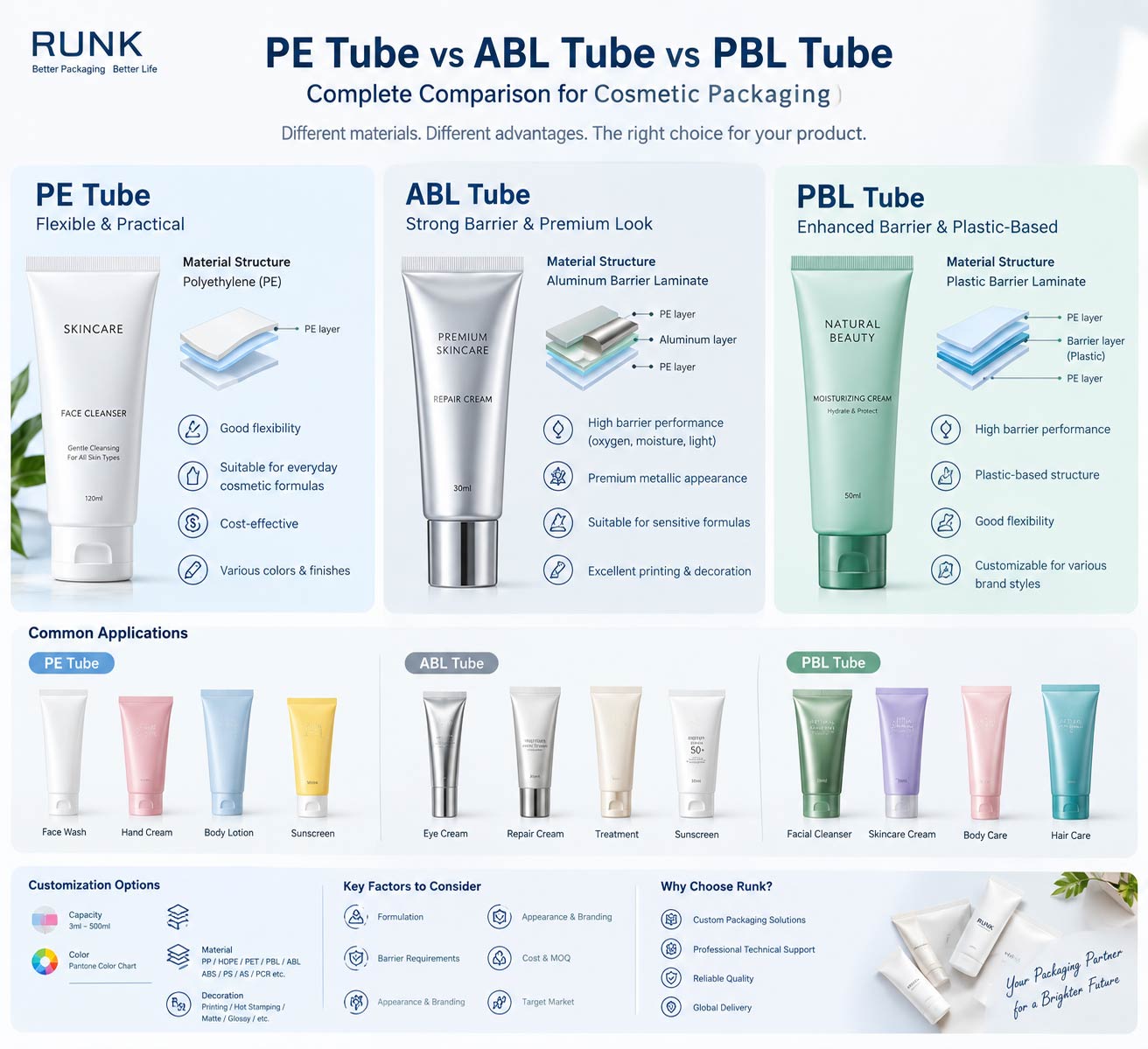
    When choosing packaging for skincare, personal care, and cosmetic products, the tube material can have a significant impact on product protection, appearance, shelf life, sustainability, and overall packaging performance.   Among the most commonly used tube materials are PE, ABL, and PBL. Each material has its own characteristics and is suitable for different cosmetic formulations and brand requirements.   For cosmetic brands, contract manufacturers, and packaging buyers, understanding the differences between PE tubes, ABL tubes, and PBL tubes can make it easier to select the right packaging solution for a specific product.   In this guide, we will compare PE Tube vs ABL Tube vs PBL Tube from multiple perspectives, including material structure, barrier properties, appearance, printing, applications, sustainability, and customization options.     1. What Are PE, ABL, and PBL Cosmetic Tubes? Before comparing the three options, it is useful to understand their basic structures. PE Tubes PE tubes are made primarily from polyethylene and are widely used for cosmetic and personal care packaging. Depending on the packaging design, PE tubes can be produced with different layers and specifications. They offer good flexibility, impact resistance, and compatibility with many everyday cosmetic formulations. PE tubes are commonly used for: Face wash Cleansing cream Hand cream Body lotion Sunscreen Hair care products Body scrub Moisturizing cream Personal care products They are a practical choice for brands looking for flexible and cost-effective tube packaging.     ABL Tubes ABL stands for Aluminum Barrier Laminate. An ABL tube typically contains an aluminum barrier layer between polymer layers. This structure provides a strong barrier against oxygen, moisture, light, and other external factors. Because of its barrier performance, ABL packaging is often selected for products that are more sensitive to environmental exposure. Common applications include: Eye cream Repair cream Skin treatment products Sunscreen High-performance skincare Pharmaceutical and personal care products Products requiring enhanced barrier protection ABL tubes can also create a premium metallic appearance that is attractive for certain cosmetic packaging designs.     PBL Tubes PBL stands for Plastic Barrier Laminate. Unlike ABL, which contains an aluminum barrier layer, PBL uses a polymer-based barrier structure. PBL tubes are designed to provide enhanced barrier performance while maintaining a plastic-based appearance and structure. They are often used for: Skincare creams Facial cleansers Sunscreen Body care products Hair care products Sensitive formulations Premium cosmetic products PBL can be a useful option when a brand requires stronger barrier performance but prefers a plastic-based packaging structure.     2. PE Tube vs ABL Tube vs PBL Tube: Key Differences The biggest differences between these three tube materials are related to their barrier structure, appearance, flexibility, product compatibility, and packaging requirements. Feature PE Tube ABL Tube PBL Tube Main structure Polyethylene Aluminum barrier laminate Plastic barrier laminate Oxygen barrier Good depending on structure High High Moisture barrier Good High High Light protection Limited to color and structure Excellent Good to high Flexibility High Good Good Metallic appearance Usually no Possible Usually no Plastic-based structure Yes No Yes Printing options Flexible Highly flexible Highly flexible Premium appearance Good Excellent Excellent Typical use Everyday cosmetics Sensitive and high-barrier formulas Cosmetics requiring enhanced barrier protection The actual performance of a tube depends not only on the material name but also on its layer structure, thickness, diameter, cap, sealing method, formulation, and manufacturing process. Therefore, brands should evaluate the complete packaging system rather than selecting a material based on one characteristic alone.   3. Barrier Performance: Which Tube Provides Better Protection? Barrier performance is one of the most important considerations when selecting cosmetic tube packaging. A packaging barrier helps protect the formulation from external factors such as: Oxygen Moisture Light Odors External contamination   PE Tube Barrier Performance Standard PE tubes can provide suitable protection for many everyday cosmetic products. They are commonly selected when the formulation does not require an extremely high barrier against oxygen or light. For products such as hand cream, body lotion, cleansing products, and many general skincare formulations, PE tubes can provide a practical packaging solution.     ABL Tube Barrier Performance ABL tubes contain an aluminum barrier layer, which can provide strong protection against oxygen, moisture, and light. This makes ABL a suitable option for formulations where external exposure may affect product stability or performance. For example, some active skincare formulations, treatment creams, and sunscreen products may benefit from enhanced barrier protection.     PBL Tube Barrier Performance PBL tubes use a plastic-based barrier structure to provide enhanced protection. They can be considered when a brand wants stronger barrier performance while maintaining a plastic-based tube structure and appearance. However, the exact barrier performance depends on the specific laminate construction selected for the packaging.     4. Which Tube Is More Suitable for Skincare Products? There is no single tube material that is suitable for every skincare product. The right choice depends on the formulation and the brand's packaging requirements. PE Tubes for Everyday Skincare PE tubes are commonly suitable for: Moisturizers Hand creams Cleansers Body creams Body scrubs General skincare products They offer a balance between flexibility, functionality, and cost.   ABL Tubes for High-Protection Skincare ABL tubes can be considered for products where enhanced protection from oxygen, moisture, and light is important. Typical applications include: Eye creams Repair creams Treatment creams Sunscreens Active skincare formulations   PBL Tubes for Barrier-Focused Cosmetic Packaging PBL tubes can be suitable for cosmetic brands looking for enhanced barrier properties with a plastic-based structure. They can be used for: Facial creams Cleansers Sunscreens Body care products Hair care products Sensitive formulations The final choice should ideally be confirmed through compatibility and stability testing with the actual formulation.     5. PE Tube vs ABL Tube vs PBL Tube: Appearance Packaging appearance plays an important role in cosmetic branding. PE Tube Appearance PE tubes can be produced in different colors and finishes and can support various printing and decoration techniques. They are suitable for both simple everyday packaging and customized branded designs.   ABL Tube Appearance ABL tubes can provide a distinctive metallic appearance because of the aluminum barrier layer. This can help create a premium visual effect, especially when combined with printing, glossy finishes, matte finishes, or other decorative treatments.   PBL Tube Appearance PBL tubes can provide a clean and modern appearance while maintaining the benefits of a plastic barrier laminate structure. They can be customized with different colors, finishes, and printing effects to match different brand identities.   6. Printing and Decoration Options Cosmetic brands often require packaging that can communicate their visual identity clearly. Depending on the tube structure and design, common decoration options include: Silk Screen Printing Offset Printing Hot Stamping Plating Frosted Finish Matte Finish Glossy Finish Pearl Effect Labeling Shiny Decoration For premium cosmetic packaging, multiple decorative techniques can also be combined. For example, a tube may use a matte body with glossy printing and hot stamping to create a more sophisticated visual effect.     7. Flexibility and User Experience The flexibility of a cosmetic tube directly affects how consumers use the product. PE tubes are generally flexible and easy to squeeze, making them popular for products designed for frequent use. ABL and PBL tubes can also provide good squeezability, but the overall user experience depends on the tube diameter, wall structure, material combination, and product viscosity. The packaging should therefore be evaluated together with the formula. A thick cream, lightweight lotion, cleansing gel, and sunscreen may require different tube structures even when they use the same general tube material.   8. Sustainability Considerations Sustainability is becoming increasingly important in cosmetic packaging. When comparing PE, ABL, and PBL, it is important to consider more than just the base material. Factors such as: Material composition Number of layers Recycled content Production process Packaging weight Transportation efficiency Recycling infrastructure Local packaging regulations can all influence the overall environmental profile of a packaging solution. For brands developing sustainable packaging, PCR and bio-based material options may also be considered where technically appropriate. The recyclability of a specific tube should always be evaluated according to its actual material structure and the recycling system available in the target market.   9. Cost Considerations Packaging cost depends on many factors, so PE, ABL, and PBL should not be compared only by material price. The total packaging cost may be affected by: Tube material Tube diameter Capacity Wall thickness Number of layers Cap design Decoration Printing colors Surface finishing Order quantity Mold requirements Packaging and shipping PE tubes are often considered a practical solution for standard cosmetic applications. ABL and PBL tubes may be selected when additional barrier performance or a specific premium packaging appearance is required. For large-volume projects, the most appropriate solution should be evaluated based on both packaging performance and total project cost.     10. How to Choose the Right Cosmetic Tube Material? When selecting between PE, ABL, and PBL, cosmetic brands can consider the following questions: 1. Does the formula require enhanced barrier protection? If the product is particularly sensitive to oxygen, moisture, or light, ABL or PBL may be worth considering.   2. What type of cosmetic product is being packaged? A hand cream, facial cleanser, sunscreen, eye cream, and treatment product may have different packaging requirements.   3. What appearance does the brand want? If a metallic or premium appearance is important, ABL can provide distinctive visual possibilities.   4. Does the brand have sustainability requirements? Brands should evaluate the complete material structure and target-market recycling system rather than looking only at whether the tube is labeled plastic or laminate.   5. What is the target price? The packaging solution should match the product's positioning and expected production volume.   6. What decoration is required? Printing and finishing requirements can influence the most suitable tube construction.   11. Cosmetic Tube Customization Options At Runk, cosmetic tubes can be customized according to four main options: Capacity Tube capacity ranges from 3ml to 500ml. The available capacity depends on the tube diameter and overall tube design.   Color Tube colors can be customized according to the Pantone Color Chart, helping brands create packaging that matches their visual identity.     Material Different material options can be selected according to product and packaging requirements, including: PP HDPE PET PBL ABL ABS PS AS PCR Sugarcane-based materials Other suitable material structures   Decoration Available decoration options can include: Silk Screen Printing Shiny Decoration Offset Printing Plating Frosted Finish Matte Finish Glossy Finish Labeling Pearl Effect Hot Stamping The final combination can be developed according to the product formula, packaging requirements, target market, and brand positioning.     12. PE Tube vs ABL Tube vs PBL Tube: Which One Should You Choose? Instead of asking which material is universally better, cosmetic brands should ask which tube structure is better suited to the specific product. PE tubes can be a practical choice for everyday skincare and personal care products that require flexible and customizable packaging. ABL tubes can be considered when stronger barrier protection and a distinctive premium appearance are important. PBL tubes can be considered when enhanced barrier performance is required while maintaining a plastic-based laminate structure. The best packaging solution depends on the formulation, product stability requirements, appearance, sustainability goals, decoration, capacity, and target market.   Frequently Asked Questions About PE, ABL, and PBL Tubes 1. What is the main difference between PE and ABL tubes? The main difference is the barrier structure. PE tubes primarily use polyethylene, while ABL tubes contain an aluminum barrier layer between polymer layers. ABL tubes generally provide stronger protection against oxygen, moisture, and light.   2. What is the difference between ABL and PBL tubes? ABL means Aluminum Barrier Laminate, while PBL means Plastic Barrier Laminate. ABL uses an aluminum barrier layer, while PBL uses a plastic-based barrier structure. Both can provide enhanced barrier protection, but their material structures, appearance, processing characteristics, and recycling considerations can differ.   3. Are PE tubes suitable for sunscreen? PE tubes can be used for sunscreen products, depending on the formulation and packaging requirements. For sunscreen formulas that require enhanced protection from external factors, brands may also consider ABL or PBL structures. Packaging compatibility and stability testing should be performed with the final formulation.   4. Are ABL tubes suitable for eye cream? Yes. ABL tubes are commonly considered for products such as eye creams and repair creams where enhanced barrier protection is desirable. The final packaging structure should still be selected according to the actual formula.   5. Are PBL tubes recyclable? The answer depends on the specific PBL structure and the recycling infrastructure in the target market. Because PBL tubes may contain multiple polymer layers and barrier materials, brands should evaluate the actual construction and local recycling requirements before making recyclability claims.   6. Which tube material is best for active skincare products? There is no universal answer. Active skincare products can have different sensitivities to oxygen, light, moisture, and other environmental factors. ABL or PBL may be considered when enhanced barrier performance is required, while PE can be suitable for formulations with less demanding barrier requirements.   7. Can PE, ABL, and PBL tubes all be customized? Yes. Cosmetic tubes can be customized in terms of capacity, color, material structure, and decoration, depending on the specific tube design and manufacturing requirements.   8. What tube sizes are available? Cosmetic tubes can be produced in different capacities for different applications. At Runk, tube capacity can range from 3ml to 500ml, with the available capacity depending on the tube diameter and design.     9. Can cosmetic tubes be printed with a brand logo? Yes. Depending on the tube structure and design, options such as silk screen printing, offset printing, hot stamping, labeling, matte finishing, glossy finishing, and other decorative techniques can be used.   10. Can the tube color match our brand color? Yes. Custom tube colors can be developed according to the Pantone Color Chart, helping brands maintain consistent visual branding across their packaging.   11. Which tube is more suitable for premium cosmetic packaging? Both ABL and PBL can be used for premium cosmetic packaging, while PE tubes can also achieve a premium appearance through customized colors, printing, and surface decoration. The final appearance depends on the complete packaging design rather than the tube material alone.   12. How do I choose the right tube for my cosmetic formula? Consider the following factors: Product formulation Barrier requirements Product sensitivity to oxygen or light Product viscosity Desired capacity Tube diameter Brand appearance Decoration requirements Sustainability goals Target market and packaging regulations If you are unsure which structure is suitable, packaging suppliers can evaluate the formula and product requirements before confirming the final tube specification.     Conclusion PE, ABL, and PBL tubes each have their own advantages and application scenarios.   PE tubes offer flexible and practical packaging solutions for many everyday cosmetic and personal care products.   ABL tubes provide an aluminum barrier layer and can be suitable for products requiring enhanced protection, while also offering a distinctive premium appearance.   PBL tubes provide a plastic-based barrier structure and can be considered for products requiring enhanced barrier performance with a plastic laminate construction.   For cosmetic brands, the right choice should be based on the formula, barrier requirements, appearance, sustainability considerations, decoration, capacity, and target market.   At Runk, we provide customized cosmetic packaging solutions for skincare, personal care, beauty, and other applications. Our team can help develop tube packaging based on your product requirements, including capacity, color, material, and decoration.   Whether you need PE, ABL, PBL, or another suitable cosmetic tube structure, choosing the right packaging from the beginning can help create a more reliable product and a stronger brand presentation.   Contact : info@runkgroup.com | +86-13128608159 Runk Website : https://www.runkgroup.com/ https://www.runkbottle.com/ https://runkpackaging.en.alibaba.com/ Based in Guangzhou, China – serving beauty brands worldwide.  
    Read More

  • How to Choose the Right Cosmetic Tube Packaging for Your Skincare Brand
    How to Choose the Right Cosmetic Tube Packaging for Your Skincare Brand
    Sep 15, 2026
    How to Choose the Right Cosmetic Tube Packaging for Your Skincare Brand Choosing the right cosmetic tube packaging is an important decision for any skincare brand. Packaging does much more than hold a formula. It protects the product, influences the user experience, communicates the brand image, and can even affect production, transportation, and long term product stability.   With so many cosmetic tube options available today, including PE tubes, PBL tubes, ABL tubes, PCR materials, sugarcane based materials, different caps, applicators, capacities, and decoration methods, it can be difficult to know which option is right for your skincare product.   The best cosmetic tube is not necessarily the most expensive or the most visually attractive one. It is the one that creates the right balance between formula compatibility, product protection, user experience, brand positioning, sustainability, customization, and cost.   In this guide, we will explain the key factors skincare brands should consider when choosing cosmetic tube packaging and how Runk can help develop a packaging solution that matches your product and brand.     1. Start With Your Skincare Formula The first question should not be: What does the tube look like? Instead, start with: What will be inside the tube? Different skincare formulas have different requirements. A lightweight cleanser, rich body cream, sunscreen, facial moisturizer, exfoliating scrub, or active skincare treatment may require different packaging structures. For example, cosmetic tubes are commonly used for: Facial cleanser Facial cream Moisturizer Sunscreen Hand cream Body lotion Body cream Body scrub Eye cream Sleeping mask Facial mask BB cream Hair care products Formula viscosity, sensitivity to oxygen or light, chemical compatibility, dispensing requirements, and expected shelf life should all be considered before selecting the final tube structure. A packaging sample may look excellent during the initial development stage, but the actual filled product should be tested with the selected packaging to evaluate compatibility, sealing, leakage, deformation, discoloration, dispensing performance, and transportation conditions. This is why packaging selection should be considered together with the formula rather than as a separate design decision.     2. Choose the Right Cosmetic Tube Material Material is one of the most important factors when selecting cosmetic tube packaging. Different materials provide different levels of flexibility, barrier protection, appearance, sustainability options, and cost efficiency. Common cosmetic tube materials and structures include PE, PBL, ABL, PCR, and bio based materials such as sugarcane based PE.     PE Cosmetic Tubes PE or polyethylene is one of the most widely used materials for cosmetic tube packaging. PE tubes are lightweight, flexible, easy to squeeze, and suitable for a wide range of skincare and personal care applications. They can also be customized in different colors, capacities, diameters, shapes, closures, and decoration styles. PE cosmetic tubes are commonly suitable for: Facial cleansers Hand creams Body lotions Moisturizers Sunscreens Hair care products Body care products For brands looking for a practical combination of flexibility, appearance, customization, and cost efficiency, PE tubes can be an excellent starting point.   PBL Cosmetic Tubes PBL stands for Plastic Barrier Laminate. PBL tubes use a multilayer plastic structure designed to provide enhanced barrier properties while maintaining a flexible tube format. Depending on the structure and formulation requirements, PBL tubes can be considered for skincare products that require additional protection compared with a basic tube structure. PBL can also provide a smooth surface for high quality decoration and premium packaging designs. For brands that want to balance product protection, appearance, flexibility, and sustainability considerations, PBL may be an attractive option. However, the exact structure should always be selected according to the formulation and required packaging performance.   ABL Cosmetic Tubes ABL stands for Aluminum Barrier Laminate. ABL tubes contain an aluminum barrier layer within the laminate structure, providing strong protection against light and helping reduce the transmission of oxygen and moisture. This can be useful for formulas that require a higher level of barrier protection. ABL tubes are often considered for products where formula protection is an important priority. However, brands should not select ABL simply because it offers a higher barrier. The complete packaging system, formula, filling process, transportation conditions, and sustainability goals should all be considered.   PCR Cosmetic Tubes PCR stands for Post Consumer Recycled material. PCR packaging allows brands to incorporate recycled material into their packaging strategy and can support sustainability focused product positioning. PCR materials may be suitable for skincare brands that want to reduce reliance on virgin plastic while maintaining a familiar cosmetic tube format. The exact PCR percentage and structure should be evaluated based on the product requirements, appearance expectations, regulatory requirements, and target market. For brands making environmental claims, it is also important to ensure that sustainability claims accurately reflect the actual packaging structure and applicable market requirements.     Sugarcane Based Materials Sugarcane based PE is another material option for brands exploring bio based packaging solutions. It can help brands develop packaging with a different sustainability story while maintaining the familiar performance characteristics of polyethylene based packaging. This option can be particularly interesting for skincare brands with a natural, clean beauty, or sustainability focused positioning. As with any packaging material, the final selection should be based on the complete product and packaging requirements rather than marketing positioning alone.   3. Select the Right Tube Capacity The capacity of your cosmetic tube should match both the product usage and your target customer. A small tube can be convenient for travel, sampling, trial products, and premium skincare products. Larger tubes are often more suitable for products designed for frequent or high volume use. Common applications include: Capacity Typical Applications 5ml to 20ml Eye cream, sample products, travel skincare 20ml to 50ml Facial cream, sunscreen, hand cream 50ml to 100ml Cleanser, moisturizer, sunscreen 100ml to 200ml Body lotion, body cream, hair care 200ml and above Body care and professional use The ideal capacity depends on your formula, recommended usage, retail positioning, customer habits, and target market. For example, a 40ml to 120ml tube can be a flexible option for products such as hand cream, sunscreen, facial cream, cleanser, body lotion, and body scrub.     4. Consider Tube Diameter and Shape Tube diameter affects more than appearance. It also influences: Grip Squeezing experience Product dispensing Visual proportions Filling requirements Label and printing area Shelf appearance Slim tubes can create a lightweight and portable appearance, while wider tubes can provide more visual impact and a larger decoration area. Runk provides different cosmetic tube diameter options, including approximately 13mm, 16mm, 19mm, 22mm, 25mm, 30mm, 35mm, 40mm, 45mm, and 50mm, as well as customized options depending on the product structure. The tube shape can also be customized according to brand requirements. A round tube may provide a classic skincare appearance, while an oval or specially shaped tube can help a product stand out on retail shelves.   5. Choose the Right Cap or Applicator The closure is an important part of the overall packaging experience. A good tube body combined with the wrong closure can still create a poor user experience. Depending on the product, brands can consider: Flip top caps Screw caps Nozzle caps Long nozzle applicators Roller applicators Massage applicators Metal tip applicators Airless tube systems For a facial cleanser, a simple flip top or screw cap may be sufficient. For an eye cream, a precision applicator may provide better control. For a massage cream or treatment product, a roller or massage applicator can create a more distinctive user experience. The dispensing system should always match the formula viscosity and intended application method.       6. Think About Your Brand Identity Cosmetic packaging is also a visual communication tool. Before selecting colors and decoration, consider how you want customers to perceive your skincare brand. For example: Minimalist Skincare Clean colors, simple typography, matte surfaces, and restrained decoration can create a modern and professional appearance.   Premium Skincare Metallic effects, hot stamping, glossy finishes, sophisticated colors, and high quality printing can create a more luxurious appearance.   Natural Beauty Soft colors, simple structures, and sustainability focused materials can support a natural or clean beauty positioning.   Clinical Skincare Simple layouts, white or neutral colors, clear product information, and functional packaging structures can communicate a scientific and professional image. Runk supports customized colors, materials, tube structures, caps, printing, and surface finishing to help brands develop packaging that fits their visual identity.     7. Select the Right Decoration Method Decoration is another important part of cosmetic tube development. Depending on the desired appearance, brands can consider: Offset printing Silk screen printing Hot stamping Labeling Matte finish Glossy finish Frosted finish Pearl effects Metallic effects The decoration method should be selected based on artwork, material, quantity, budget, and desired visual effect. For example, a simple logo and product name may work well with silk screen printing, while premium metallic details may benefit from hot stamping. For large areas of detailed graphics, offset printing may provide more design flexibility. A professional packaging supplier can help evaluate which decoration method is most suitable for your artwork and selected tube structure.     8. Consider Sustainability From the Beginning Sustainability should not be treated as an afterthought. If environmental responsibility is part of your brand strategy, it should be considered during the initial packaging development stage. Depending on the project, skincare brands may consider: PCR materials Sugarcane based materials Mono material structures Lightweight packaging Reduced material usage Recyclability considerations Optimized packaging dimensions However, sustainable packaging is not simply about choosing a material labeled as eco friendly. Brands should also consider the complete packaging structure, closure, decoration, transportation, product protection, and applicable recycling systems in the target market. At Runk, we work with customers to evaluate suitable material options based on product requirements and packaging goals rather than applying one material solution to every project.   9. Do Not Forget Formula Compatibility Testing One of the most important steps in cosmetic packaging development is compatibility testing. Even when a tube is visually perfect, the packaging still needs to work properly with the actual formula. Testing may include: Formula compatibility Leakage testing Sealing testing Cap tightness testing Dispensing testing Drop testing Transportation testing Appearance inspection Printing inspection Usage testing Factors such as temperature, storage time, transportation conditions, formula ingredients, and packaging materials can all affect the final result. For this reason, brands should test the actual filled product rather than relying only on an empty packaging sample.   10. Balance Quality and Cost The cheapest cosmetic tube is not always the most cost effective choice. A low unit price may become less attractive if the packaging creates problems during filling, transportation, storage, or consumer use. At the same time, choosing an unnecessarily complicated packaging structure can increase costs without providing meaningful benefits. A good packaging solution should balance: Function + Appearance + Quality + Sustainability + User Experience + Cost This is especially important for new skincare brands that need attractive packaging while maintaining a controlled product development budget.   11. Why Work With Runk for Custom Cosmetic Tubes? Runk is a professional cosmetic packaging manufacturer serving beauty and personal care brands worldwide. With more than 15 years of average industry experience across the Runk team, the company provides customized packaging solutions for cosmetic tubes, bottles, jars, Airless packaging, and paper boxes. For cosmetic tubes, Runk supports OEM and ODM customization across multiple aspects of packaging development.   Custom Tube Solutions Runk can support customization of: Tube diameter Tube capacity Tube shape Tube material Tube color Cap style Applicator Printing Surface finishing Runk's cosmetic tube solutions include PE, PBL, ABL, PCR, and selected bio based material options according to project requirements. The company also supports different tube structures and applications for skincare, hair care, body care, and beauty products.   One Stop Cosmetic Packaging In addition to cosmetic tubes, Runk provides bottles, jars, Airless packaging, and paper boxes. This gives brands the opportunity to source multiple packaging components from one experienced packaging partner and maintain greater consistency across a product line.   Quality Control Runk's quality management process includes raw material inspection and production quality control, together with testing such as color testing, compatibility testing, sealing testing, scratch testing, drop testing, usage testing, and transportation testing for newly developed packaging projects. For international beauty brands, Runk also provides global customer support and has an Indonesia office serving customers in Southeast Asia.     Frequently Asked Questions About Cosmetic Tube Packaging 1. What is the best cosmetic tube material for skincare products? There is no single best material for every skincare product. PE, PBL, ABL, PCR, and bio based materials each have different characteristics. The best choice depends on the formula, barrier requirements, appearance, sustainability goals, target market, and budget. The actual filled product should be tested with the selected tube before mass production.   2. Are cosmetic tubes suitable for sunscreen? Yes. Cosmetic tubes are widely used for sunscreen products. However, sunscreen formulas can have specific packaging compatibility and protection requirements. The appropriate tube structure, material, cap, and decoration should be selected according to the formulation and testing results.   3. Can cosmetic tubes be used for facial cleanser? Yes. Facial cleanser is one of the common applications for cosmetic squeeze tubes. A flexible PE tube with a suitable cap can provide convenient dispensing and good portability for daily facial cleansing products.   4. Can I customize the color of a cosmetic tube? Yes. Custom colors can be developed according to your brand requirements, including standard color references and customized color matching. Color selection should be confirmed through samples before mass production because the final appearance can be affected by the material and decoration process.   5. Can I print my logo directly on the tube? Yes. Depending on the selected tube structure and artwork, logo and product information can be applied using different decoration methods such as offset printing, silk screen printing, hot stamping, or labeling.   6. Can the tube shape and size be customized? Yes. Runk supports customized tube diameters, capacities, shapes, colors, caps, applicators, and decoration methods. Customized dimensions should be evaluated according to the filling process, product capacity, formula viscosity, and intended user experience.   7. What cosmetic products can be packaged in tubes? Cosmetic tubes can be used for many skincare and personal care products, including: Facial cleanser Facial cream Sunscreen Moisturizer Eye cream Hand cream Body lotion Body scrub Facial mask Hair mask Hair treatment BB cream Personal care products The appropriate tube structure should be selected according to the formula and application.   8. What is the difference between PE, PBL and ABL tubes? The main difference is their material structure and barrier performance. PE tubes use polyethylene based structures and are widely used for flexible cosmetic packaging. PBL tubes use a plastic barrier laminate structure and can provide enhanced barrier performance. ABL tubes use an aluminum barrier layer and are designed for applications requiring strong barrier protection. The right choice depends on the specific product rather than simply choosing the material with the highest barrier performance.   9. Are PCR cosmetic tubes more sustainable? PCR materials can help brands incorporate recycled content into their packaging. However, sustainability depends on the complete packaging system, including material composition, PCR percentage, product design, transportation, recycling infrastructure, and the requirements of the target market. Brands should make environmental claims based on verified packaging specifications and applicable regulations.   10. What is the MOQ for custom cosmetic tubes? MOQ depends on the tube structure, material, capacity, decoration method, customization requirements, and production process. Standard products and highly customized packaging projects may have different MOQ requirements. Runk can review your project specifications and provide a more accurate quotation and MOQ recommendation.   11. How long does custom cosmetic tube production take? Production time depends on the product structure, customization requirements, sampling process, decoration, quantity, and production schedule. For this reason, it is best to confirm the timeline after the packaging specifications and sample requirements have been finalized.   12. Can Runk provide samples before mass production? Yes. Sample development is an important part of customized cosmetic packaging. Samples allow brands to evaluate the appearance, dimensions, color, closure, dispensing experience, and compatibility with their product before proceeding to mass production.     13. What information should I provide when requesting a cosmetic tube quotation? To receive a more accurate quotation, you can provide: Product type Tube capacity Preferred material Tube diameter Tube shape Cap or applicator Color Logo or artwork Decoration requirements Estimated order quantity Target market Delivery destination Reference images, drawings, or existing packaging samples can also help the packaging team understand your requirements more quickly.   14. Can Runk help if I do not have a complete packaging design? Yes. Runk provides both OEM and ODM packaging support. If you already have a complete packaging specification, Runk can manufacture according to your requirements. If you only have a product concept, reference image, capacity requirement, or basic brand direction, the Runk team can help evaluate suitable packaging options and develop a customized solution.     Final Thoughts: Choose Packaging That Works for Your Brand Choosing the right cosmetic tube packaging is not simply a question of choosing a beautiful tube. The right solution should protect the formula, provide a comfortable user experience, match the brand identity, support production requirements, meet sustainability goals where appropriate, and remain commercially practical. Before making a final decision, consider these six questions: Does the material match my formula? Does the tube provide sufficient product protection? Is the capacity suitable for my customers? Does the design communicate my brand identity? Does the packaging support my sustainability goals? Can the supplier provide consistent quality and reliable customization? By considering these factors together, skincare brands can make more informed packaging decisions and avoid unnecessary changes later in the development process.   At Runk, we believe cosmetic packaging should be developed around the product, the brand, and the customer.   Whether you are launching a new skincare product, upgrading existing packaging, developing a sustainable product line, or looking for a reliable OEM and ODM cosmetic packaging partner, Runk can help you explore suitable cosmetic tubes, bottles, jars, Airless packaging, and paper box solutions.   Have a cosmetic packaging project in mind? Share your product type, capacity, preferred material, quantity, and packaging requirements with the Runk team. We can help you evaluate suitable packaging options and develop a customized solution for your skincare brand.     Contact : info@runkgroup.com | +86-13128608159 Runk Website : https://www.runkgroup.com/ https://www.runkbottle.com/ https://runkpackaging.en.alibaba.com/ Based in Guangzhou, China – serving beauty brands worldwide.  
    Read More
  • Innovating Responsible Cosmetic Packaging Tube for the Beauty Industry
    Innovating Responsible Cosmetic Packaging Tube for the Beauty Industry
    Aug 20, 2026
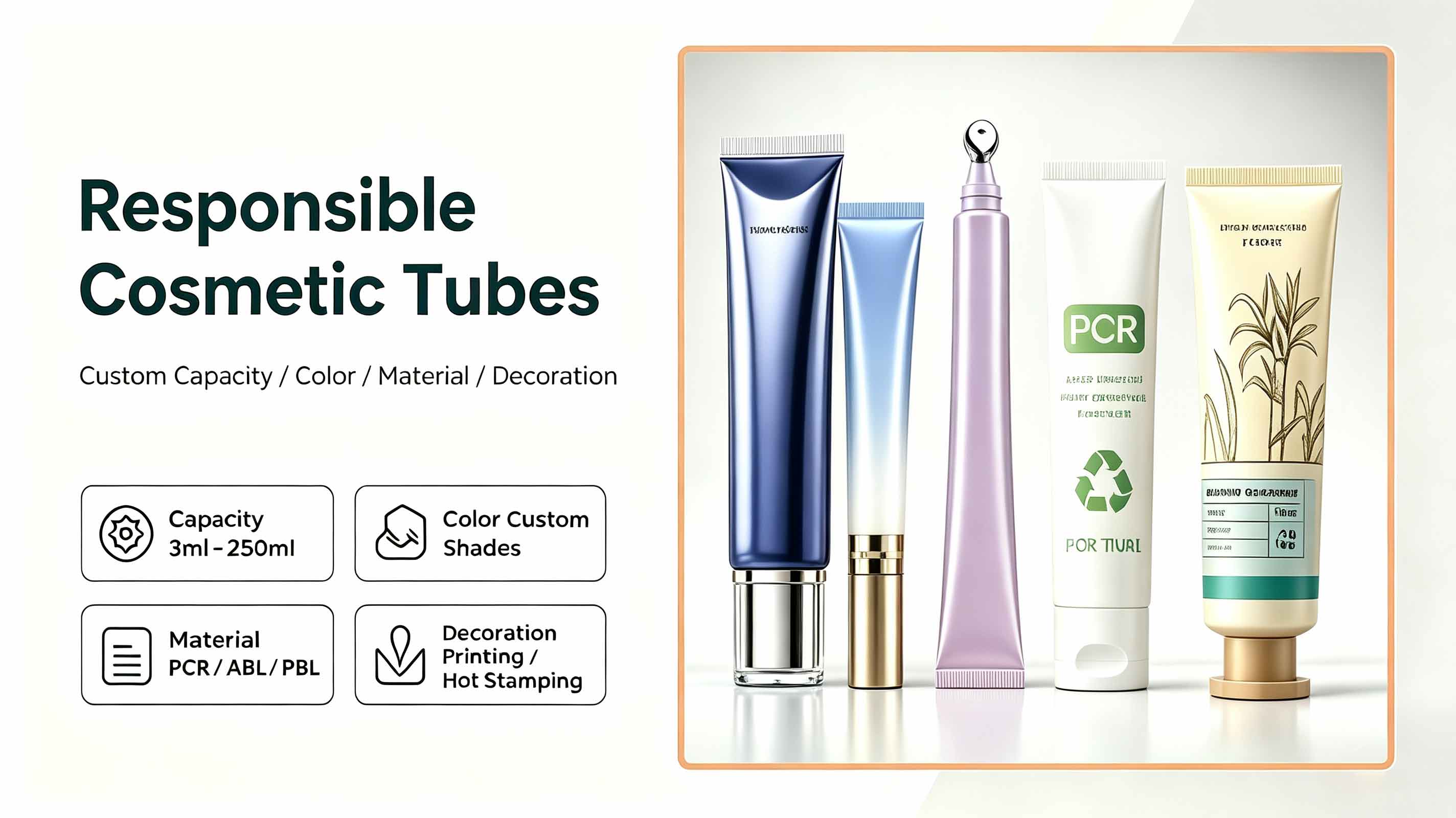
    Innovating Responsible Cosmetic Packaging Tube for the Beauty Industry The beauty industry is evolving rapidly. Consumers are paying closer attention not only to the products they use, but also to how those products are packaged, transported, used, and disposed of.   For cosmetic and personal care brands, packaging has therefore become an important part of product development. A well-designed cosmetic packaging tube needs to provide reliable protection and convenient dispensing while also supporting brand identity, production requirements, and more responsible packaging goals.   As a professional cosmetic packaging manufacturer, Runk continues to develop innovative cosmetic packaging tubes that combine functionality, customization, attractive design, and material-conscious solutions for the global beauty industry.   From skincare and haircare to body care and personal care products, Runk provides flexible cosmetic tube packaging solutions designed around different product applications and brand requirements.     What Is Responsible Cosmetic Packaging? Responsible cosmetic packaging is not simply about using a material labeled as "eco-friendly." A more comprehensive approach considers the entire packaging solution, including material selection, product protection, packaging weight, manufacturing processes, usability, transportation, customization, and end-of-life considerations. For cosmetic brands, responsible packaging can involve several different strategies: Selecting suitable materials according to the product application Reducing unnecessary packaging components Optimizing packaging size and weight Designing packaging for efficient transportation Using recyclable or recycled-content materials where appropriate Improving dispensing efficiency Developing packaging with practical and durable structures Reducing unnecessary decorative elements Creating packaging that supports the brand's long-term product strategy There is no single packaging solution that is ideal for every cosmetic product. The right approach is to find a balance between product protection, functionality, aesthetics, manufacturing feasibility, and environmental considerations.   Why Cosmetic Packaging Tubes Are Important Cosmetic tubes are widely used across the beauty and personal care industry because they offer a practical combination of convenience, protection, and flexible design.   They can be used for many different products, including: Facial cleanser Hand cream Body lotion Sunscreen Moisturizer Eye cream Face cream Hair care products Body care products Scrubs Masks Personal care products Compared with some rigid packaging formats, tubes can provide convenient dispensing and are easy for consumers to carry and use. For brands, tubes also provide a large printable surface that can be used to communicate product information and create a recognizable visual identity.     Runk Cosmetic Packaging Tubes: Designed for Different Applications Different cosmetic products have different formulas, viscosities, dispensing requirements, and positioning. Runk develops cosmetic tube packaging solutions for different applications rather than treating every product as the same.   Skincare Tubes Skincare products often require packaging that combines a clean appearance with convenient dispensing. Runk cosmetic tubes can be developed for products such as: Facial creams Eye creams Moisturizers Sunscreens Cleansing products Treatment products Masks Different tube sizes, caps, applicators, and decoration methods can be selected according to the product concept.   Hand Cream Tubes Hand cream packaging needs to be portable and easy to squeeze and dispense. Compact cosmetic tubes can provide a practical solution for daily use, travel, handbags, and retail products. Brands can customize the tube color, printing, cap, and surface finish to create different visual styles.   Body Care Tubes For body care products, larger capacities may be required. Tube packaging can be designed for body lotion, body scrub, body cream, and other personal care applications. Different capacities and dispensing components can be selected according to product viscosity and usage requirements.   Applicator Tubes For products that benefit from targeted application, functional applicators can provide an enhanced user experience. Depending on the product design, cosmetic tubes can be combined with specialized applicators such as roller balls, massage applicators, or other functional dispensing heads. This approach allows the packaging itself to become part of the product experience.     Material Selection for More Responsible Packaging Material selection plays an important role in responsible cosmetic packaging. Different materials have different characteristics, production requirements, appearance, durability, and recycling considerations. Runk can provide cosmetic tube solutions using different material combinations according to product and project requirements. Common options may include:     PE Cosmetic Tubes PE is widely used in cosmetic packaging because of its flexibility, durability, and suitability for many personal care applications. PE tubes can also be customized in different colors and decorated according to brand requirements.     Recycled Material Options For brands with specific sustainability objectives, recycled materials or recycled-content solutions may be considered where technically and commercially appropriate. The suitability of recycled material should be evaluated according to the cosmetic formula, packaging performance, appearance requirements, regulatory requirements, and target market.   Sugarcane-Based PE Options Bio-based PE derived from sugarcane can be considered for brands looking for alternative material solutions. Unlike conventional plastic materials, bio-based PE uses renewable feedstock as part of its raw material source. However, brands should evaluate the complete packaging structure and relevant claims rather than assuming that one bio-based component automatically makes the entire package environmentally superior.   Full Customization for Cosmetic Packaging Tubes Modern beauty brands are looking for packaging that is recognizable and consistent with their brand identity. Runk supports flexible customization for cosmetic tube packaging.   Tube Shape Customization Tube shape can influence both appearance and user experience. Depending on the project, brands can discuss different tube shapes, dimensions, shoulder structures, and component combinations. A distinctive tube shape can help a product stand out from standard packaging on retail shelves.   Capacity Customization Different cosmetic products require different capacities. Runk can provide different tube capacity options for applications ranging from compact travel-size products to larger body care packaging. Capacity should be selected based on: Product dosage Usage frequency Product positioning Target consumer Retail channel Transportation requirements   Color Customization Color is one of the most important visual elements in cosmetic packaging. Runk can support customized colors according to brand requirements, including solid colors, transparent effects, gradient effects, and other visual finishes. Brands can also develop a consistent color system across multiple products within the same collection.     Printing and Decoration Cosmetic tubes provide a relatively large surface area for branding and product information. Decoration options may include: Silk screen printing Hot stamping Labeling Offset printing Metallic effects Matte finishing Glossy finishing Frosted effects The final decoration method depends on the tube material, surface, artwork, desired visual effect, and production requirements.     Functional Tube Heads for Better User Experience Packaging functionality is another important part of responsible cosmetic packaging design. A package that allows consumers to dispense the appropriate amount of product can contribute to a more convenient user experience and help reduce unnecessary product waste. Runk can develop cosmetic tubes with different dispensing and applicator solutions according to the application. Examples include:   Standard Screw Caps Screw caps provide a simple and reliable closure solution for many cosmetic and personal care products.   Flip Top Caps Flip top caps allow consumers to open and close the package quickly with one hand and are commonly used for everyday skincare and personal care products.   Applicator Heads Specialized applicator heads can provide a more targeted application experience. For products such as eye care, massage, and treatment products, applicator components can become an important part of the overall packaging concept.     Why Customization Matters for Beauty Brands Customization is not only about making packaging look different. It can also help brands develop packaging around the actual product. For example, a brand may need: A smaller tube for travel products A larger tube for body care A soft tube for easy squeezing A specialized applicator for targeted application A specific cap for improved usability A particular material for a packaging strategy A unique color to match brand guidelines Premium decoration for high-end products By considering these requirements during the development stage, packaging can become more closely connected to the product itself.     Responsible Packaging Requires a Balance Sustainable packaging discussions can sometimes focus too heavily on a single material or environmental claim. In reality, responsible packaging is more complicated.   A packaging solution needs to protect the cosmetic formula throughout its intended shelf life. If the package cannot properly protect the product, product loss may outweigh the intended benefits of a packaging change.   For this reason, responsible cosmetic packaging should consider several factors together: Product Protection + Material Selection + Packaging Efficiency + User Experience + Manufacturing + Transportation + End-of-Life Considerations   This balanced approach allows brands to make packaging decisions based on their actual products and business requirements.   How to Choose the Right Cosmetic Tube Before selecting a cosmetic packaging tube, brands should consider the following questions.   1. What Is the Product Formula? The formula's viscosity, ingredients, sensitivity, and dispensing requirements can influence the choice of tube material and structure.   2. What Is the Desired Capacity? Capacity should reflect the intended dosage, usage frequency, product positioning, and sales channel.   3. How Will Consumers Use the Product? A hand cream designed for handbags may require a different packaging format from a body lotion designed for home use.   4. Does the Product Need a Special Applicator? If the packaging needs to provide massage, targeted application, or other functions, a specialized tube head may be appropriate.   5. What Is the Brand's Visual Identity? Tube color, printing, finishing, cap design, and overall shape should work together as part of the brand's visual system.   6. What Are the Brand's Packaging Goals? If a brand has specific sustainability objectives, material selection and packaging structure should be discussed at the beginning of the project rather than after the design has already been finalized.   From Concept to Mass Production Developing a customized cosmetic tube usually involves several stages.   Step 1: Requirement Analysis The manufacturer first needs to understand the product application, capacity, formula characteristics, target market, expected quantity, and design requirements.   Step 2: Packaging Recommendation Based on the requirements, suitable tube structures, materials, caps, applicators, and decoration options can be recommended.   Step 3: Artwork and Customization Confirmation The brand provides artwork, colors, logos, and other design requirements. The manufacturer then confirms whether the design is suitable for the selected packaging structure and production process.   Step 4: Sample Development Samples allow the customer to evaluate the actual packaging before mass production. Brands can check: Tube appearance Color Size Printing Cap assembly Applicator function Dispensing performance Overall user experience   Step 5: Compatibility Evaluation For cosmetic products with specific formulas, compatibility testing between the formula and packaging is recommended. This helps identify potential issues such as leakage, deformation, discoloration, or changes in packaging performance.   Step 6: Mass Production After specifications and samples are confirmed, production can proceed according to the approved requirements. Quality control should cover appearance, dimensions, decoration, component assembly, sealing, and overall packaging consistency.   What Makes Runk a Reliable Cosmetic Tube Manufacturer? Runk focuses on providing cosmetic packaging solutions for global beauty and personal care brands. Our capabilities cover different types of cosmetic packaging, including tubes, bottles, jars, and Airless packaging solutions. For cosmetic tubes, Runk focuses on several key areas:     Flexible Customization Tube shape, capacity, material, color, cap, applicator, printing, and surface finishing can be customized according to project requirements.   Product-Oriented Development Packaging selection is considered together with the product application, formula requirements, dispensing method, and user experience.   Professional Manufacturing Stable production and quality control are important for maintaining packaging consistency during mass production.   Responsible Material Consideration Runk works with customers to evaluate suitable material options based on their product requirements and packaging goals.   OEM and ODM Support Whether a customer already has a complete design or is developing a new packaging concept, Runk can support different stages of the packaging development process.     Frequently Asked Questions About Cosmetic Packaging Tubes 1. What products can be packaged in cosmetic tubes? Cosmetic tubes can be used for a wide range of products, including facial cream, eye cream, sunscreen, hand cream, body lotion, cleanser, scrub, mask, hair care products, and personal care products. The appropriate tube structure should be selected according to the formula and dispensing requirements.   2. Can cosmetic tubes be fully customized? Yes. Runk supports customized cosmetic tube solutions, including tube shape, capacity, material, color, cap, applicator, printing, and surface finishing.   3. Can I customize the tube with my own logo? Yes. Logo printing can be customized according to the selected tube material, surface, artwork, and printing method.   4. What printing methods can be used on cosmetic tubes? Depending on the packaging material and design, options may include silk screen printing, hot stamping, offset printing, labeling, and other decorative techniques.   5. Can I customize the color of the tube? Yes. Brands can develop customized colors according to their visual identity and product positioning. A physical sample should be evaluated before mass production to confirm the final color effect.   6. Can I customize the cap? Yes. Different cap structures and designs can be matched with cosmetic tubes according to the product requirements. Options may include screw caps, flip top caps, and specialized functional components.   7. Can cosmetic tubes have special applicators? Yes. Depending on the application, cosmetic tubes can be developed with functional applicators such as roller or massage components. Applicator selection should consider the formula, application method, cleaning requirements, and intended user experience.   8. Are cosmetic tubes environmentally friendly? The answer depends on the complete packaging structure and the materials used. A cosmetic tube should not automatically be considered environmentally friendly simply because it uses a particular material. Brands should evaluate material composition, packaging weight, product protection, manufacturing, transportation, and end-of-life considerations together.   9. Can I use recycled materials for cosmetic tubes? Recycled-content materials may be available for certain applications. However, the suitability depends on the formula, performance requirements, appearance, regulatory requirements, and target market. A packaging manufacturer should evaluate the specific project before recommending a material.   10. What is bio-based PE? Bio-based PE is polyethylene made partly or entirely from renewable biological feedstocks rather than conventional fossil-based feedstocks. Sugarcane-based PE is one example of a bio-based material option that may be considered for certain cosmetic packaging applications. The final packaging structure and environmental claims should be evaluated carefully before marketing.   11. How do I choose the right tube material? The choice should consider: Formula compatibility Product viscosity Required flexibility Barrier requirements Appearance Decoration Target market Transportation Sustainability goals Cost There is no universal material that is suitable for every cosmetic product.   12. How can I test whether a cosmetic tube is compatible with my formula? The recommended approach is to test the actual cosmetic formula with the selected packaging. Testing may evaluate appearance, leakage, deformation, discoloration, dispensing performance, and other relevant characteristics over the expected storage period.   13. What information should I provide when requesting a quotation? For a more accurate quotation, customers can provide: Product type Tube capacity Preferred material Estimated quantity Tube shape Cap or applicator requirements Color Logo or artwork Printing requirements Surface finishing Target market Delivery destination Reference images or drawings are also helpful when developing customized packaging.   14. What is the MOQ for customized cosmetic tubes? MOQ depends on the selected tube structure, material, customization requirements, decoration method, and production process. Standard packaging and highly customized packaging projects may have different MOQ requirements. Runk can confirm the specific MOQ after reviewing the project requirements.   15. How long does it take to produce customized cosmetic tubes? The production timeline depends on the selected packaging structure and customization requirements. Existing tube structures generally require fewer development steps, while new molds, special materials, customized colors, and complex decoration may require additional time. The specific production schedule can be confirmed after the project specifications are finalized.   16. Can small cosmetic brands order customized tubes? Yes. Small and emerging beauty brands can discuss suitable packaging options based on their expected quantity, budget, product positioning, and customization requirements. Using an existing tube structure with customized colors and printing may be an efficient option for brands that do not need a completely new mold.   17. Can cosmetic tubes be used for private label products? Yes. Cosmetic tubes are widely used for private label skincare, body care, hair care, and personal care products. Brands can customize the packaging appearance and branding elements according to their product strategy.   18. Can Runk help develop a completely new cosmetic tube? For projects requiring a unique structure, Runk can discuss customized development based on the customer's concept, drawings, reference samples, dimensions, and expected application. The feasibility, tooling requirements, development process, MOQ, and estimated cost should be evaluated individually for each project.     The Future of Cosmetic Packaging Is More Thoughtful The future of beauty packaging is not simply about creating packaging that looks attractive. It is about creating packaging that performs well, supports the product, provides a better user experience, reflects the brand identity, and considers responsible material and manufacturing choices. Cosmetic tubes offer brands a flexible platform for achieving these goals.   With the right combination of materials, structure, capacity, dispensing components, decoration, and manufacturing technology, cosmetic tube packaging can become an important part of a successful beauty product. Runk continues to explore innovative cosmetic packaging solutions for the evolving beauty industry, helping brands find a practical balance between functionality, customization, aesthetics, quality, and responsible packaging goals.   Looking for a Customized Cosmetic Packaging Tube? Whether you are launching a new skincare product, developing a private label collection, upgrading existing packaging, or exploring more responsible packaging options, Runk can help you evaluate suitable cosmetic tube solutions. Share your product type, capacity, formula requirements, reference design, estimated quantity, or packaging concept with our team.   Runk is ready to help turn your cosmetic packaging idea into a practical, customized solution for the global beauty market.   Contact : info@runkgroup.com | +86-13128608159 Runk Website : https://www.runkgroup.com/ https://www.runkbottle.com/ https://runkpackaging.en.alibaba.com/ Based in Guangzhou, China – serving beauty brands worldwide.    
    Read More
  • How to Choose the Right Cosmetic Packaging for Your Brand
    How to Choose the Right Cosmetic Packaging for Your Brand
    Feb 25, 2026
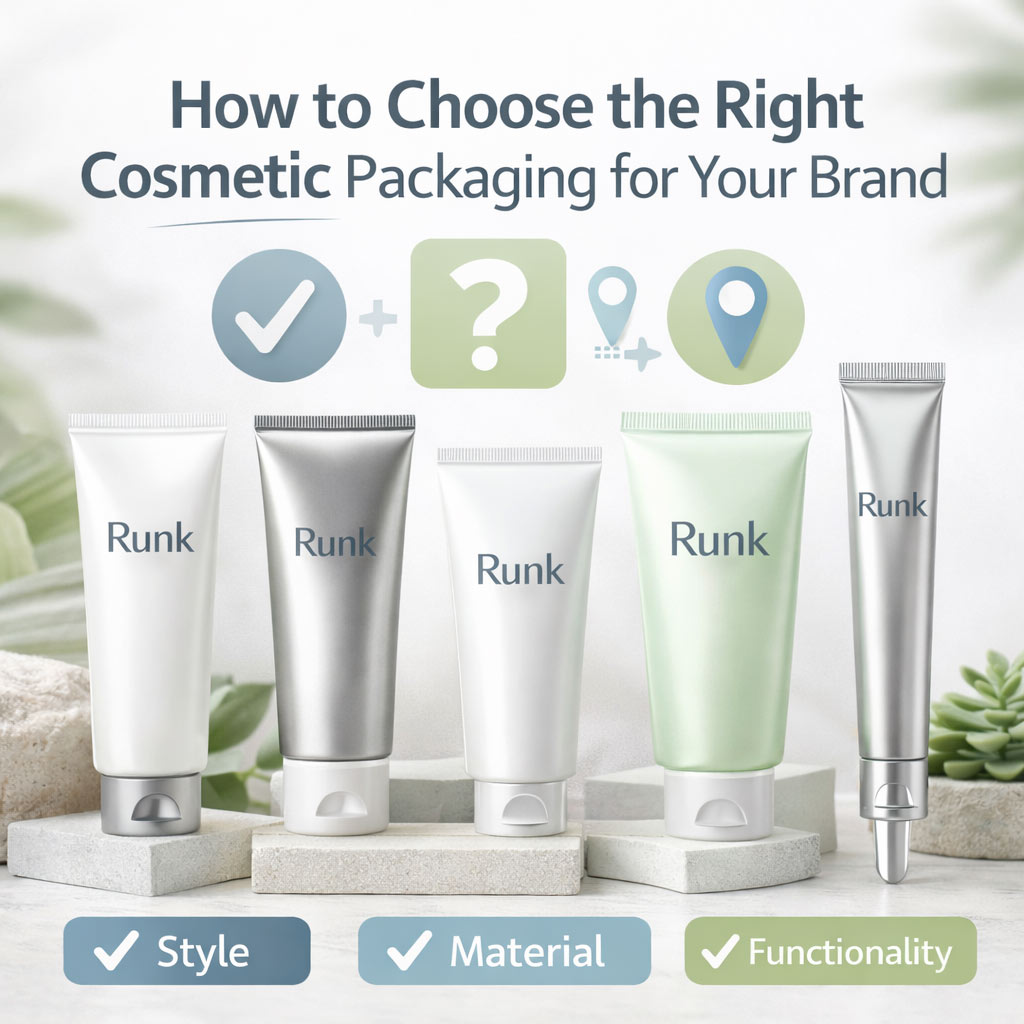
    How to Choose the Right Cosmetic Packaging for Your Brand In the beauty industry, packaging is more than protection — it is your brand’s first impression. The right cosmetic packaging communicates quality, reflects your brand identity, and influences purchasing decisions within seconds. Whether you are launching a new skincare line or expanding an existing collection, choosing the right packaging requires strategic planning.   Here’s a practical guide to help you make the best decision for your brand.     1. Define Your Brand Positioning Before selecting packaging, clearly define your brand identity: • Is your brand luxury or minimalist? • Is it eco-conscious or dermatology-focused? • Is your target audience premium, mass market, or niche?   For example, high-end skincare brands often choose thick-wall cream jars, airless pump bottles, or metallic finishes to create a premium feel. Natural or clean beauty brands may prefer frosted bottles, earthy tones, and recyclable materials.     Your packaging should visually communicate your brand story at first glance.   2. Match Packaging Type to Product Formula Different skincare and cosmetic formulas require different packaging structures: ♦ Creams & Balms → Cosmetic jars ♦ Lotions & Serums → Pump bottles or airless bottles ♦ Cleansers & Sunscreens → Squeeze tubes ♦ Eye creams & Spot treatments → Small applicator tubes       Airless pump bottles are especially suitable for sensitive or high-value formulas because they reduce air exposure and improve product preservation. Always ensure material compatibility with your formulation to prevent leakage, corrosion, or chemical reactions.   3. Select the Right Materials Common cosmetic packaging materials include: ♠ PET – Transparent, durable, recyclable ♠ PP – Lightweight, chemical-resistant ♠ PE – Flexible, ideal for tubes ♠ PCR materials – Sustainable recycled plastics   If sustainability is part of your brand mission, consider recyclable mono-material packaging, refillable systems, or PCR options. Eco-friendly packaging enhances brand credibility in global markets.   4. Focus on Functionality & User Experience Beautiful packaging attracts attention, but functionality builds loyalty. Consider: ♣Is the pump smooth and durable? ♣ Is the tube easy to squeeze? ♣ Does the cap seal securely to prevent leaks? ♣ Is the applicator hygienic and convenient?     User-friendly design improves customer satisfaction and repurchase rates.   5. Consider Customization & Branding Customization transforms standard packaging into branded packaging. Options may include: ♥ Custom colors (matte, glossy, gradient, soft-touch) ♥ Silk screen printing & hot stamping ♥ Embossed or debossed logos ♥ Private mold development ♥ Unique shapes and decorative finishes     Consistent packaging design across tubes, bottles, and jars strengthens brand recognition both online and in retail stores.   6. Evaluate Production Capacity & Supply Stability Reliable supply is critical for growing brands. When choosing a packaging manufacturer, evaluate: ⇒ Production scale and automation level ⇒ Quality control systems ⇒ Lead times and delivery reliability ⇒ OEM & ODM capabilities     A stable long-term partner ensures consistent quality and scalable production as your brand expands.   7. Balance Cost and Value While cost matters, the cheapest packaging is not always the best choice. Consider the balance between: • Unit price • Durability and protection • Brand image • Customer perception   Investing in high-quality packaging often leads to stronger brand positioning and higher perceived value.   Final Thoughts Choosing the right cosmetic packaging for your brand is a strategic decision that impacts product performance, brand image, and long-term growth. By aligning packaging type, material, functionality, customization, and supply capability with your brand goals, you create packaging that not only protects your product — but also elevates your brand in a competitive market.     If you are seeking professional guidance on customized cosmetic tubes, bottles, or jars, partnering with an experienced packaging manufacturer can help you turn your brand vision into reality.   Website:https://runkpackaging.en.alibaba.com                https://www.runkgroup.com | https://www.runkbottle.com Contact : info@runkgroup.com | +86-13128608159   Based in Guangzhou, China – serving beauty brands worldwide.    
    Read More
  • What is the most eco-friendly packaging for cosmetics?
    What is the most eco-friendly packaging for cosmetics?
    Dec 26, 2024
    The best packaging material for skin care products depends on various factors, such as the specific product, its ingredients, and environmental considerations. However, some commonly used packaging materials for skin care products include:   Glass: Glass is a sustainable and eco-friendly packaging material as it is recyclable and reusable. It is inert and provides a barrier against external elements, preventing product degradation. Glass packaging is often chosen for high-end or luxury skin care products.   Aluminum: Aluminum is lightweight, recyclable, and offers excellent protection against light and air, making it suitable for sensitive or light-sensitive skin care products. It is commonly used for products like serums, creams, and lotions.   PET (Polyethylene Terephthalate) Plastic: PET plastic is a widely used packaging material in the cosmetic industry. It is lightweight, durable, and recyclable. PET plastic offers good barrier properties, preserving the product's integrity and preventing leakage. PCR (Post-Consumer Recycled) Plastic: PCR plastic is made from recycled materials, such as plastic bottles or containers. It helps reduce the consumption of new plastics and lessens the environmental impact. Many brands are incorporating PCR plastic packaging to promote sustainability.   Paperboard: Paperboard packaging is considered eco-friendly as it is renewable, biodegradable, and recyclable. It is often used for secondary packaging, like boxes and cartons, for skin care products.   Ultimately, the choice of packaging material should consider a balance between product protection, aesthetics, brand positioning, and environmental impact.   RUNK: We are China Plastic Tube Packaging factory. Professional Plastic Tube Packaging supplier, offer high quality Plastic Tube at factory price! Inquiry now! info@runkgroup.com    
    Read More
  • What is a cosmetic tube?
    What is a cosmetic tube?
    Nov 29, 2024
    A Cosmetic tube is a type of packaging used to contain and dispense various cosmetic products, such as creams, lotions, gels, serums, and ointments. It is a cylindrical container typically made of plastic or aluminum, with a narrow opening at one end and a closure mechanism, such as a cap or nozzle, at the other end. Cosmetic tubes are available in different sizes and shapes, including squeeze tubes, rollerball tubes, and airless tubes. They are designed to protect the product from contamination, facilitate easy dispensing, and provide convenience for consumers in applying and using cosmetic.                                         RUNK: We are China Plastic Tube Packaging factory. Professional Plastic Tube Packaging supplier, offer high quality Plastic Tube at factory price! Inquiry now! info@runkgroup.com    
    Read More
  • Eye care tubes can help with common eye problems
    Eye care tubes can help with common eye problems
    Nov 01, 2024
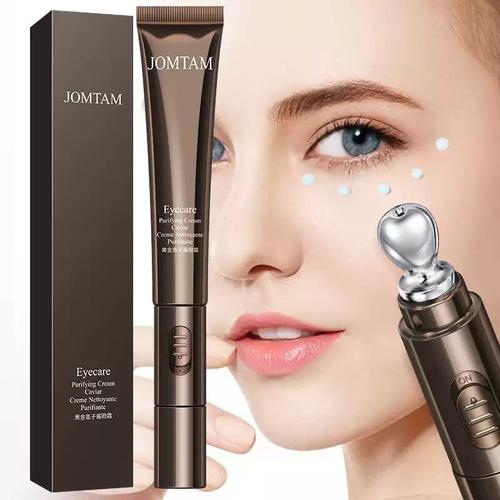
    Eye care tubes help address several common eye issues through their design: 1.Precise application: Eye care tubes are typically equipped with small openings or droppers, allowing for accurate application of the product to the target area, such as the skin around the eyes or the roots of the eyelashes. This helps avoid overuse or wastage of the product and ensures precise coverage of the desired area. 2.Preserving product freshness: Eye care tubes often come in sealed packaging, effectively protecting the product from air, light, and contaminants. This design helps extend the product's shelf life and ensures freshness and potency when used.   3.Convenient portability: The compact design of eye care tubes makes them easy to carry, allowing for eye care anytime, anywhere. This is especially convenient for individuals who prioritize eye health, travel frequently, or require frequent touch-ups. 4.Preventing cross-contamination: Due to the sensitive nature of the eye area, using shared or easily contaminated skincare products may increase the risk of infection. The design of eye care tubes can help reduce the risk of cross-contamination, as each user can have their own individual tube. In summary, eye care tubes enhance the effectiveness and convenience of eye care products through precise application, product freshness preservation, portability, and reduced risk of cross-contamination.   RUNK: We are China Plastic Tube Packaging factory. Professional Plastic Tube Packaging supplier, offer high quality Plastic Tube at factory price! Inquiry now! info@runkgroup.com  
    Read More

leave a message

leave a message
If you are interested in our products and want to know more details,please leave a message here,we will reply you as soon as we can.
submit

home

products

WhatsApp

Contact Us